The volatile world of the video games investor

Nintendo Wii activities reach a new audience - Photo by Daniel Morrison on Flickr licensed under Creative Commons

Video games: still a long term growth story

For a few years now the video/computer games sector has looked attractive as an investor. 

As most people would now be aware video games have passed movies in terms of gross revenue and there are a bunch of  factors which make them extremely interesting as a long term growth story.

For example:

  1. increased availability of high speed broadband
  2. increased availability of large, high definition screens in the home
  3. the growth of whole new genres which are different from the traditional shoot-em-ups such as edutainment titles which teach children far more effectively than any human teacher could, and gaming physical fitness titles exemplified by the Nintendo’s Wii Fit series which have redefined the user interface so that physical activity forms a strong component of the game
  4. social gaming systems such as World of Warcraft (owned by Activision) with 11m players
  5. new generations for whom gaming is not a marginal activity such as the under 20s and increasing numbers of women gamers

At the same time as a sector it’s pretty damn scary. 3-5 year console cycles cause stock prices to fluctuate like a yo-yo and it perhaps bears a passing resemblance with large title production costs and big marketing budgets to the movie business (not a business that looks tempting as organisations like Vivendi and Sony have learned to their cost). Equally there is the argument that, like the music business, titles can be pirated with high speed connections. Looking at all this you just have to keep reminding yourself equity investors really get returns for taking on risk…

However something that has significantly changed is that the multiples on all these gaming stocks have fallen over the last couple of years which is what makes them more interesting at the moment from the perspective of a value investor in what used to be regarded entirely as a growth stock play.

The big cap pure-play video games companies

Nintendo Wii mainstream family entertainment - photo by Shyns Darky on Flickr licensed under Creative CommonsThe three big (pure) players are Activision, Electronic Arts, and Nintendo (given the risk levels on individual titles the smaller companies seem to be significantly riskier). None of these companies have any debt and all have significant cash on the balance sheet (in Nintendo’s case net assets excluding intangibles accounts for over a third of its market cap – about US$8bn of which is cash).

Whilst Sony and Microsoft are of course large in the games industry as well they also have other priorities and it looks hard on the surface of it to disentangle their games activities and the resulting impact on their stock prices from their other businesses.

Long term (see chart here) Activision seems to have tracked Nintendo (both of which are generally thought to have excellent management teams) up until the beginning of 2009, whilst comparatively Electronic Arts has languished in the last 2 years (EA focusing heavily on sports titles compared to the other two).

Comparative valuations for Activision, Nintendo and Electronic Arts

Some comparative valuation metrics for all three stocks are listed below:


Valuation Comparisions 14/12/09 Forward PE Price / Cashflow Price / Cashflow 3 yr avg Market Cap USD Billion Rev Growth 1Y %
Activision 14.06 21.55 54.43 13.6 124
Electronic Arts 13.61 62.11 53.86 5.2 15
Nintendo 12.09 13.33 54.28 34 10


There is some degree of fear out there on these stocks – see “Can Nintendo Rebuild?” for example in Businessweek. Generally video game sales have not been good recently (Nintendos’ sales fell for about 8 months straight this year and it expects annual revenues to fall for the first time in 6 years), there is nervousness about the impact of social gaming via systems like Facebook, and the rise and rise of iPhone games has made people wonder what impact that might have on dedicated handheld devices like the Nintendo DS or Sony PSP.

Nintendo, for example is trading at half its price in 2007:

 
 and even Activision with the recent success of its Call of Duty: Modern Warfare title is trading at $10 or so from a high of $18 back in 2007 (but not an apples for apples comparison given its 2008 merger with Blizzard and their World of Warcraft franchise). 

Of these 3 stocks it is Nintendo that seems to jump out (although both Activision and Electronics Arts are trading below Morningstar’s fair value estimate and it would probably be entirely reasonable to take a diversified bet on all 3).

The case for investing in NintendoNintendo pioneers the fitness related video game - photo by fer3d on Flickr licensed under Creative Commons?

As a US$34bn company with the majority market share in many areas (Sony has sold about 9m PS3 units in the UK with Nintendo selling 25m Wiis)  Nintendo is surprisingly hard to find investor coverage on – Morningstar in the USA for example does not provide analysis on it.

If the reason is concerns about the way that some Japanese companies are run, these don’t seem warranted in Nintendo’s case.  At current stock prices they even pay a 5% dividend – the only company of these three to do so and a rarity in the games industry generally.

Nintendo is however definitely a long term bet. Their revenue has halved in the last 6 months compared to a year ago and a chartist probably wouldn’t touch them with a bargepole.

However they are still busily shipping units of the Wii (with a price cut) and the portable DS (with roughly 10% of the all time entire total sold in the last 6 months) and if you look at their geographical revenue split what happens in the US is both very important but equally very impacted by US dollar weakness (the USD having fallen against the Yen by about 20% over the last 2 years).


Nintendo by region  
6 months to Sept 30th 2009 (million yen)
     
Japan 92071 17%
Americas 228938 42%
Europe 186630 34%
Other 40418 7%
     
Nintendo by activity type
6 months to Sept 30th 2009 (million yen)
     
Hardware 312556 57%
Software 234187 43%


As the activity type table above suggest Nintendo is not just a hardware company with revenue over this period (during which not many new titles were released) being split about half software, half hardware. Recent falls in revenue reflect a lack of new compelling titles or hardware launches but the company’s franchise with casual gamers places less stress on coming up with radical new cutting edge consoles (as is the case perhaps with the Xbox or Playstation). Their Mario Brothers franchise is still going strong and the title was released in 1983!

The concerns about the iPhone seem to be overrated to me. The iPhone lacks gaming controls so you have to use your fingers on the screen (reducing its visual area), it comes with data charges, and to argue that gaming apps are cheaper for the iPhone is a little like arguing  that nobody is going to go to the cinema because they can watch movies for free on television (the better movie experience still counts for the consumer).  Just on that minor point $10 for  cinema ticket for a one-off 2 hour’s enjoyment still seems to be outranked by potentially weeks of enjoyment in sharing a game with your family at home.

The Super Mario Brothers game - released by Nintendo in 1983 - photo by Peter Hellberg on Flickr licensed under Creative Commons
Neither, if you look at Nintendo’s R&D spend, does it look like Nintendo intends to stand still with a high definition Wii supposedly in the works as well as link-ups with organisations like Netflix. Yes, motion-sensing controllers may well be on the way from Sony and Microsoft but this is a company with a history of innovation.

Nintendo’s management has successfully broken into whole new areas – with a market share for example of up to 80% of US female gamers and almost singlehandedly created a new genre, the fitness/exercise game.

Nintendo’s profitability and track record makes their US ADRs look like a buy (US: NTDOY) and the rumours of a stock split would make them more attractive as well. However looking at their chart averaging in looks warranted – this is not for the faint-hearted.

More information on Activision at http://investor.activision.com/reports.cfm
More information on Nintendo at http://www.nintendo.co.jp/ir/en/

Posted under individual stocks

This post was written by mike on December 14, 2009

Tags:

Commercial property trust / REIT investment using an Exchange Traded Fund (ASX:SLF)

Bombed out commercial real estate courtesy of StephYo on Flickr licensed under Creative CommonsIn the never-ending quest for the unpopular asset class that you might be able to pick up on the cheap it is difficult to go past commercial real estate at the moment.

But there are a few problems:

  1. commercial real estate can be very illiquid
  2. with the gearing in this sector, falling property values, and historically low interest rates that may increase, there may be risk in a particular fund that it is hard to identify

So what might be interesting would be a commercial real estate exchange traded fund that is both liquid and spread across a number of different property trusts.

In Australia you can find exactly this with the State Street Spider S&P/ASX 200 Listed Property Fund (roughly $15 billion market cap with 16 holdings and a .4% management cost with quarterly income distributions).

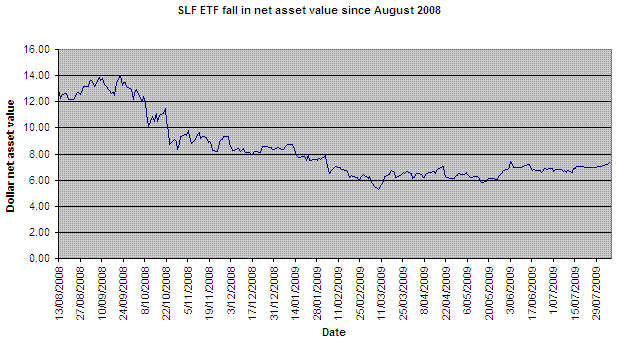
SLF Net Asset Value has halved over the last year

If your approach to buying stocks is chartist/technical, stop reading here because the chart (ASX:SLF)
 is a bit ugly to look at, with net asset value at 1/2 of its 12 month high, and down 2/3rds over the last 2 years.

SLF ETF fall in net asset value since Aug 08

SLF ETF fall in net asset value since Aug 08

We have started (and intend to continue) buying it in multiple small parcels and as a long term investment.

SLF income picture

SLF is currently trading at a  nominal double digit yield which is estimated to fall to about 8-9% i.e. you can assume that a further fall in income distribution is already factored into the current price.

Roughly 7 out of 10 of the top 10 holdings are trading at single digit PEs and the outlook from analysts for the whole property industry is still gloomy.

Stock-Specific Risk in SLF

It seems strange to talk about stock specific risk with an ETF but as of August 7th Westfield made up 47% of total assets so if you don’t like Westfield don’t buy this (here are the top 10 holdings): 

Issue Name Sector Classification % of Total Assets
Westfield Group Retail Reits 47.09
Stockland Diversified Reits 13.11
Gpt Group Diversified Reits 7.83
Cfs Retail Prop Retail Reits 6.30
Dexus Property Gp Diversified Reits 6.11
Mirvac Group Diversified Reits 5.32
Cmnwlth Prop Offic Office Reits 2.97
Ing Office Fund Office Reits 2.64
Goodman Group Industrial Reits 2.21
Macquarie Office Office Reits 1.91
Macquarie Countryw Retail Reits 1.32
Bunnings Warehouse Industrial Reits 0.99
Abacus Property Gr Diversified Reits 0.66
Ing Industrial Fd Industrial Reits 0.61
Charter Hall Group Diversified Reits 0.58
Astro Japan Proper Diversified Reits 0.35

Here’s the sector breakdown:


Sector % of Total Assets
Retail Reits 54.34
Diversified Reits 34.42
Office Reits 7.51
Industrial Reits 3.73

Like it? Hate the idea? Let us know by commenting below!

Posted under index trackers

This post was written by mike on August 8, 2009

Tags: , ,

Dollar cost averaging in volatile equity markets

Does dollar cost averaging really work better in a volatile equity market?

Say that your equity market outlook assumes that one of two scenarios is true.  Either:

  1. You expect equity markets to be volatile over the next 10 years or,
  2. You are convinced that neither you nor anyone else knows what equity markets are going to do over the next 10 years!

but you still expect equities to outperform other asset classes over this term.

In this kind of environment a program of drip-feeding funds into the market makes sense as most research seems to suggest that market timers usually do worse than a more unemotional dollar cost averaging process

What is dollar cost averaging?

Dollar cost averaging refers to the process of investing the same amount to some regular timescale. When the price of the equities is low you will acquire more, and when high you will acquire less.

It may seem obvious, but is still worth stating, that dollar cost averaging essentially delays investing, which means that broadly as prices tend to rise over time this may reduce your returns…

Dollar cost averaging however itself has two problems aside from the implied delay element:

  1. There are transaction costs
  2. Can it be automated?

Transaction costs of dollar cost averaging

Ostensibly the transaction costs do not seem that high. You can download a very simple Excel model where you can put your own portofolio figures in here: Dollar cost averaging share purchases transaction costs.  

On the basis of $150k portofolio spread out over 10 sectors asset allocation sectors, with 10 trades per sector (100 trades in all), at $32 per trade (eTrade’s costs in Australia to private investors) you are looking at a transaction cost of around 2.13% on the whole portfolio using a dollar cost averaging strategy in establishing your portfolio:

Total sector holding 15000 Total portfolio size 150000
       
Total brokerage cost per sector 320 Total brokerage cost for portfolio 3200
       
Percentage return reduction for sector in brokerage 2.13% Percentage return reduction for portfolio in brokerage 2.13%

Can you fully automate dollar cost averaging?

In an ideal world many time-poor private investors would prefer to set up a plan in advance e.g. ‘complete my dollar cost averaging plan over the next 2 years’, for example.  

This raises the question of whether share purchase orders set ‘at market’  or ‘at best’ can be poorly priced, whether deliberately or accidentally by the broker?

The short answer is the jury is out …. there didn’t appear to be any easily identifiable research and presumably it differs on a broker by broker basis.

However a common-sense approach might suggest that low liquidity shares with bigger bid/ask spreads might be more at risk of mispricing than broadly traded shares or ETFs.   

Know better? Comment below.

Posted under investment strategies, market timing

This post was written by mike on July 21, 2009

Tags: , ,

Cheapest online supermarket shopping: Coles Online or Woolworths Homeshop?

Photo by auxesis from Flickr licensed under Creative Commons

Why Woolworths and Coles pricing matters

Supermarket expenses account for about 16% of our annual household expenditure for our family of 4 (2 adults, 2 children excluding mortgage costs). In cash terms, roughly $25,000 per year, and the second highest category of expenditure in the household after childcare. The Australian competition regulator, the ACCC, in an enquiry last year (2008) identified groceries as representing 12-14% of the average household’s after tax income.

The price of supermarket goods year-in year-out therefore has a quite significant impact on household savings.

Whilst there are new entrants coming in like Costco and Aldi the ACCC still considers the market ‘workably competitive’  but notes in its July 2008 report that there are “limited incentives for Coles and Woolworths to compete aggressively on price”.

Online supermarket shopping: checking the pricing of Coles Online versus Woolworths Homeshop

The increasingly sophisticated nature of Coles and Woolworths online shopping operations means you can monitor comparative pricing for the basket of groceries your particular home normally buys.  This is because both online websites enable you to save a ’shopping basket’ of regular items. You can also see on the sites when goods are ‘on special’.

Unlike physically visiting a supermarket it doesn’t make a lot of difference to an online buyer where the food comes from e.g. you don’t have to understand the store layout and you basically don’t care whether the food has to travel 5 kilometres or 15 kilometres to get to you. So some concerns that have been raised about the limitations of the government’s ‘Grocery Watch’ price monitoring may not apply to online shopping so much.

Basically if you’re willing to recreate your normal shopping basket on “the other supermarket’s website” it’s easy to switch (and in our experience it may take you a couple of hours to do this once you print out your list and re-enter each item).

Who is really cheaper: Coles Online or Woolworths Homeshop?

The results from our household basket of about 54 branded items based on our last 6 months purchases (the absolutely identical item from both supermarket chains that you can find at the bottom of this article) was that although more of the items were slightly cheaper at Woolworths the difference was so marginal  that it’s not worth worrying about (the average item price difference across the two supermarkets was less than 1%).

In the end our 54 item basket came out at $334 at Woolworths and $333 at Coles (see below). However if one takes into account the delivery charges for the two chains (the minimum delivery charge at Woolworths is currently $5 and at Coles it’s $9) it all comes out almost identical again.

Are all online products similarly priced though? 

Despite the list below which suggests an average individual price difference of less than 1% (we’re sure the supermarkets themselves monitor eachother closely which may account for this extremely close pricing) we suspect that not all pricing is so equal.  

Our list was based on absolutely identical products. What we could not easily comparatively price, were goods like own-branded goods, and we’re sure the supermarkets are aware of this in the assumptions they make themselves about organisations like the ACCC trying compare their prices or even many individual shoppers comparing pricing.

In these areas the price differences can be much more marked. For example, Woolworths 3 litre milk is $3.95 where Coles 3 litre milk is $3.16, a 20% difference…

The ACCC’s report tends to bear this out:

“Price competition is strongest on promotions of key value items (which are products known by the supermarkets to be used by consumers to assess value). This is to be expected, given that the pricing of these products is most likely to encourage consumers to change where they buy
groceries.”

You need to check this with your own household basket and we suggest bread, milk, and salad may be where you find some of these more extreme differences (just don’t assume they apply across your whole groceries basket).

Are online supermarket shopping prices more expensive than in-store prices?

 We had heard this so we actually asked Woolworths by email:

“Hi, could you clarify how your Homeshop pricing compares to your in-store pricing? My assumption was that the pricing was the same with the exception of the delivery charge (which reflects your increased costs in terms of the delivery components). However I have been informed that Woolworths has a markup on online items over and above the in-store price. Is that correct? ”  

 For what it’s worth this is Woolworths’ response:

“The prices charged online are comparable to that of a metro supermarket. Not all supermarkets charge the same prices in each store for all items, therefore the prices online may differ to that of your local Woolworths supermarket. Homeshop still offers a convenient, high quality and competitively priced service direct to your door. We regularly review our pricing against other online grocery services and generally find we are cheaper on the total basket. “

We have not validated this assertion about identical instore/online pricing (subject to ‘local’ variations) by checking Woolworths dockets versus their online pricing.

However we have looked at Coles docket pricing from our local Coles versus their online operation and there did appear to be some signficant differences (see the Online v Instore column in the table below) with items like bread and butter and pasta and yoghurt between 8% and 18% cheaper in-store than via Coles Online (in fact any items we directly compared, albeit on a small sample, the online pricing was always more expensive).

We’d be interested to hear what you’ve found!

The comparative online pricing for this article from Coles and Woolworths


  Woolworths Coles Cheaper? Coles instore Online v instore
Baby              
  Huggies Baby Wipes Refill Unscented 240pk    17.26 17.43 -0.98%    
  Huggies Dry Nites Pyjama Pants For Boys 4-7Years 17-30kg 16pk    19.42 17.99 7.36%    
  Huggies Nappies Boys Walker Ultra Dry 13To16kg 64pk *limit of 6 per customer    45.3 41.95 7.40%    
Bakery              
  Burgen Pumpkin Seeds Bread 700g    5.16 4.79 7.17% 4.79 0.00%
  Lawsons Traditional Bread Settlers Grain 800g    5.28 4.89 7.39% 4 18.20%
  Lawsons Traditional Bread White 800g    5.28 4.89 7.39% 4 18.20%
  Tip Top Muffin English 6pk 400g    4.3 3.89 9.53%    
  Tip Top Raisin Toast Bread 520g    4.39 4.39 0.00%    
Cleaning              
  Finish Dishwasher Tablets All In One Regular 28ea    16.14 16.3 -0.99% 14.95 8.28%
  Thick & Thirsty Paper Towel White 2Pk    2.89 2.92 -1.04%    
Biscuits, Snacks & Confectionery              
  Arnotts Jatz Crackers 250g    2.9 2.93 -1.03%    
  Arnotts Snack Right Sultana Fruit Slice 250g    4.09 4.13 -0.98%    
  Lindt Lindor Bags Assorted 125g    5.22 6.53 -25.10%    
  Nabisco Captains Table Water Cracker 125g    1.83 1.86 -1.64%    
  The Natural Confectionery Compnay Tncc Natural Snakes 200g    2.82 2.86 -1.42%    
Breakfast Cereal & Muesli Bars              
  Kelloggs Just Right Original 890g    8.62 8.71 -1.04%    
  Sanitarium Weetbix 750g    4.52 4.57 -1.11%    
Canned Foods & Soup              
  Heinz Baked Beans Salt Reduced 220g    1.35 1.36 -0.74%    
  John West Oysters Smoked In Oil 85g    3.22 3.26 -1.24%    
Chilled & Dairy              
  Allowrie Butter Unsalted 250g    2.69 2.89 -7.43% 2.59 10.38%
  Australian Fresh Juice 100% Apple/Mango 2L    6.46 6.53 -1.08%    
  Australian Fresh Juice Apple/Mango 1L    3.98 4.02 -1.01%    
  Bega Cheese Slices Tasty Natural 500g    8.84 9.15 -3.51%    
  Bulla Cream Thickened 300ml    2.32 2.34 -0.86%    
  Bulla Thickened Cream 600ml    3.83 3.87 -1.04%    
  Don Ham Shaved Leg English Baked 250g    6.29 6.27 0.32%    
  Eco Eggs Free Range 10pk 550g    6.92 7 -1.16%    
  Jalna Bio Dynamic Yoghurt Whole Milk 500g    4.08 4.12 -0.98%    
  Jalna Yoghurt Bio Dynamic Whole Milk 1kg    7.18 7.25 -0.97% 6.65 8.28%
  Jalna Yoghurt Strawberry 500g    3.93 3.97 -1.02%    
  Mil Lel Cheese Parmesan 250g    5.82 5.88 -1.03%    
Condiments, Oils, Sauces & Spreads              
  Bertolli Oil Olive Extra Virgin 2L    25.9 26.15 -0.97%    
  Crisco Oil Peanut 750ml    6.35 6.42 -1.10%    
  Masterfoods Mustard Honey Wholegrain 175g    2.9 2.94 -1.38%    
Frozen Food              
  Birds Eye Potato Gems 1kg    4.48 4.52 -0.89%    
  Streets Blue Ribbon Ice Cream Vanilla 2L    6.79 6.86 -1.03%    
Health, Beauty & Personal Use              
  Band-aid Plastic Strips 50ea    4.13 4.17 -0.97%    
  Colgate Toothpaste Sensitive Enamel Protect 110g    8.41 8.68 -3.21%    
  Dove Deodorant Anti Perspirant Roll On 50ml    4.09 4.13 -0.98%    
  Faulding Shaving Cream Tube 75g    2.79 2.78 0.36%    
  Kleenex Facial Tissues Pocket Pack 4ply 6pk    2.9 2.93 -1.03%    
Hot & Cold Beverages              
  Bundaberg Ginger Beer 4 Pack 1500ml    4.64 4.64 0.00% 4.31 7.11%
  Cadbury Bournville Cocoa 125g    2.68 2.71 -1.12%    
  Frantelle Water Spring Natural 1.5L    1.42 1.41 0.70%    
  Pump Water 4×750 ml    7.85 7.94 -1.15%    
International Cooking              
  Pataks Paste Curry Milk Tikka Masala 283g    5.29 5.44 -2.84%    
Newsagency, Stationery & Office              
  Reflex Recycled A4 Paper Ream 1ea    6.99 7.62 -9.01%    
Rice, Noodles, Pasta & Pasta Sauce              
  Barilla Pasta Penne Rigate No 73 490g    2.79 2.82 -1.08% 2.59 8.16%
  Riviana Basmati Rice Long Grain 1kg    4.22 4.26 -0.95% 3.91 8.22%
Baking              
  Csr Icing Sugar Pure 500g    1.33 1.34 -0.75%    
  Csr Sugar Brown 500g    1.6 1.62 -1.25%    
  Hoyts Bay Leaves 15g    1.27 1.29 -1.57%    
  White Wings Flour Plain 1kg    3.22 3.26 -1.24%    
        avg diff -0.80%    
TOTAL BASKET     334.37 332.87 0.45%    

Posted under savings levels

This post was written by mike on June 14, 2009

Tags: , ,

Public beliefs about long term investment returns from different asset classes

Staggering (to me anyway) study out from Gallup a couple of weeks ago about the public’s beliefs about which asset classes offer the best long term investing returns.
 
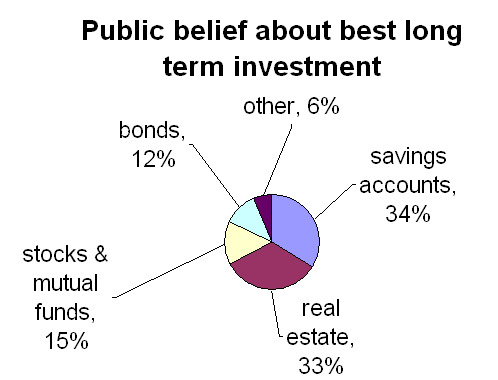
When asked “which of the following do you think is the best long term investment?” 34% of the 1000-odd telephone interviews picked savings accounts with 33% picking real estate. Stocks and mutual funds crept in at a lowly 15% (see below).
Beliefs of Americans about investment returns from different asset classes

Beliefs of Americans about investment returns from different asset classes

The thing that has bothered me over the years about investing in low cost equity tracker funds which eliminate all that stock-specific risk and have historically performed far better than any other asset class, is that they seem like such a no-brainer. Surely it is so obvious that everyone can see this with average actively managed fund performing worse than low cost passive vehicles?

And if everyone can see this then isn’t there going to be a whole pile of ‘dumb’ money piling in driving index constituents to ever higher price earnings multiples, whilst ignoring the fundamentals of these stocks? Who’s going to be left to actually look at individual stocks to do the number crunching to really evaluate their value?

Ok, I realize that nobody ever went broke (particularly casinos) by basing their business on the public thinking they were cleverer than the average Joe but still? Admittedly there is also a lot of rubbish quoted out there that makes it look like stocks do not offer good long term returns. One of my pet hates is writers just quoting the index e.g.

“the S&P is back where it was 10 years ago”

and the writer not realizing that, for example, (from Standard and Poors) dividend income has represented roughly 1/3rd of the monthly total return on the S&P 500 since 1926, ranging from a high of 53% during the 1940s to a low of 14% in the 1990s (when investors focused on growth).

But there is also a huge amount of very compelling research identifying long term returns on different asset classes…

It looks like I needn’t have worried about crowd mentality when it comes to trackers looking at this survey though!  Sadly another thing that stands out about the Gallup results is that lower income investors are more likely to view savings accounts as better investments (obviously imposing an inherent ceiling on their growing their personal wealth) although equally oddly higher income investors believe most in investment in real estate!

The study also bears out that  we investors are so into driving by looking into the rear vision mirror … with equities (now that they represent better value) falling in popularity by 15% or so over the last 2 years (the same survey has been carried out since 2003) and bonds and cash which have performed better over the same period (despite the forward inflationary risk with a wall of government debt bearing down on us) becoming much more popular…

Posted under index trackers, investment strategies

This post was written by mike on June 3, 2009

Tags: ,

Superannuation & government deficits: political risk is back

Watching the Obama government fiddle around with the various creditors in Chrysler (and in other government bailouts where political calculations are coming into play in Australia and the UK) it’s pretty obvious that there is ‘political risk’ coming back into investment in a big way.

It is something that Bill Gross at Pimco was also keen to stress in his latest podcast, “2+2=4″, that equity and debt holders may be looking at a highly regulated future where the ‘dead hand of government’ plays a significant role in setting future growth rates and income distributions (no doubt Mr Gross would be horrified by this oversimplification).

Another way to look at it is simply that the debt being run up in stimulus packages may create an irresistible temptation for governments to tap funding sources which currently might appear to be protected.

One obvious group of people who are being ’stuffed’ in the current environment are holders of cash, with interest rates of .5% in the UK or a (comparatively) generous 3% in Australia, perhaps a realization which may play a small part in the recent market runup.  In a future environment it may be that holders of non-inflation protected assets are also going to get stuffed.

As someone I know puts it more succintly, “the older generation are going to get stuffed somehow.”

However one other obvious source for governments to target are Super funds and pension funds.

As Kris Sayce puts it well in ‘Money Morning’ with regard to Australia:

“perhaps the biggest giveaway is the $1 trillion held in private superannuation accounts. At the moment these balances are almost untouchable by the government. It is up to the fund managers and trustees of the funds to decide where the money is invested.

That is a position that no government will allow to remain for too long. Not when there is a $300 billion public sector debt to be paid off. And a $100 billion public sector pension liability to be financed.

Not to mention all the increases in welfare payments that will arise in the next few years.”  

Given the time horizons involved we should all be thinking about what the government might do to get their hands on it to pay their bills. Mr Sayce’s view is that there may be inducements from the government to “swap their defined contribution super plans in return for a defined benefit government pension”, however we probably need to consider other possibilities as well. For example:

  • could the government change the tax rates on super funds from 15%?
  • could the government set maximum super fund sizes?
  • could the government change the cap on non-concessional contributions (currently $150k)?
  • could the government change the preservation age (the age most of us can access their super) – it’s been suggested that preservation age move to 67 by the interim Henry Review?
  • could the government further target temporary residents (it is already taking their unclaimed super within 6 months of them departing Australia)?
  • introduce tax on super income streams after preservation age (60), currently for most people there is no tax if the cash was taxed ‘going’ in).

From the government’s point of view there are  two risks:

  1. loss of votes amongst a segment of the population that is getting larger (retirees)
  2. reducing the savings rate (pretty much what it wants to do at the moment anyway and of course a mandatory super contribution level in effects sets a savings rate the government can fiddle with as well)

The level of risk overall should a key factor (especially for wealthier individuals given the budget changes to super) in whether you choose to put your money into the superannuation sandbox or operate outside it.

Posted under Risk, investment strategies

This post was written by mike on May 18, 2009

Tags: ,

How to create a bear market rumour: US bank ’stress test’ results

In the old (pre-internet) days to create a market rumour you actually had to go to the trouble of making a phone call to a broadsheet journalist. As a university prank we rang a major newspaper’s Property columnist, told him we were from the (fictitious) “Real Estate Institute” and did he know if there was any truth to the market rumour that there was a Sheikh in town with $200m to spend on property?

Unsurprisingly (because we’d just made it up) he didn’t know if there was any truth to it but that didn’t stop him printing it prominently the following day, “the real estate scene is abuzz with the rumour that there is a Sheikh in town with $200m to spend on some property acquisitions…” (I have no idea whether or not that benefited someone flogging property over the succeeding couple of weeks, if it did please forward me a cheque care of this blog). 

[PS Don't try this sort of thing at home, it's too easy to succeed, and probably illegal into the bargain.]

These days you don’t need to even get someone on the other end of a phone. Last Monday you could watch the internet equivalent of  this sort of rumour-mongering playing out in the blogosphere and email world and it’s interesting to take a closer look at how the rumour spread and why.

The Rumour

On Wednesday I received the following item forwarded by email:

“Monday, April 20, 2009
Stress Test Results Leaked

Posted by [name omitted] at 8:08 AM
Turner Radio Network out with a shocker on what they claim are the leaked Stress results. We paraphrase:

The Turner Radio Network has obtained “stress test” results for the top 19 Banks in the USA.

The stress tests were conducted to determine how well, if at all, the top 19 banks in the USA could withstand further or future economic hardship.

When the tests were completed, regulators within the Treasury and inside the Federal Reserve began bickering with each other as to whether or not the test results should be made public. That bickering
continues to this very day as evidenced by this “main stream media” report.

The Turner Radio Network has obtained the stress test results. They are very bad. The most salient points from the stress tests appear below.

1) Of the top nineteen (19) banks in the nation, sixteen (16) are already technically insolvent.

2) Of the 16 banks that are already technically insolvent, not even one can withstand any disruption of cash flow at all or any further deterioration in non-paying loans.

3) If any two of the 16 insolvent banks go under, they will totally wipe out all remaining FDIC insurance funding.

4) Of the top 19 banks in the nation, the top five (5) largest banks are under capitalized so dangerously, there is serious doubt about their ability to continue as ongoing businesses.

5) Five large U.S. banks have credit exposure related to their derivatives trading that exceeds their capital, with four in particular – JPMorgan Chase, Goldman Sachs, HSBC Bank America and
Citibank – taking especially large risks.

6) Bank of America`s total credit exposure to derivatives was 179 percent of its risk-based capital; Citibank`s was 278 percent; JPMorgan Chase`s, 382 percent; and HSBC America`s, 550 percent. It gets even worse: Goldman Sachs began reporting as a commercial bank, revealing an alarming total credit exposure of 1,056 percent, or more than ten times its capital!

7) Not only are there serious questions about whether or not JPMorgan Chase, Goldman Sachs,Citibank, Wells Fargo, Sun Trust Bank, HSBC Bank USA, can continue in business, more than 1,800 regional and smaller institutions are at risk of failure despite government bailouts!

The debt crisis is much greater than the government has reported. The FDIC`s “Problem List” of troubled banks includes 252 institutions with assets of $159 billion. 1,816 banks and thrifts are at risk of failure, with total assets of $4.67 trillion, compared to 1,568 institutions, with $2.32 trillion in total assets in prior quarter.

Put bluntly, the entire US Banking System is in complete and total collapse.

More details as they become available. . . . . .” 

Spreading a Rumour

There were two other interesting features about the email aside from the fact that it took two whole days (!) to get to us.

Email Your Market Rumour

Firstly, my contact had had this email to him on Tuesday by a large investment banking house which I won’t name whose employee noted that “I am sharing this not to create undue panic but simply to let you know what is out there right now” and who also noted that he was sending this to his “valued clients and friends”.

One could argue that in a sense it’s this professional investor’s job to send round stuff like this if it, a) creates a reason to do a trade (!) and b) to let his clients know what rumours are doing the rounds in the rest of the market. Of course one could also argue that there is a bunch of people out there who could also use the those relatively unknown tools available like Google to check  the truth of what they’re disseminating.

The second thing that I thought was interesting was the speed this rumour spread at and how it spread.  In email terms there were already 3 headers from three different on-forwarders on the version of this story I sent.  Assume, for example, that each person in those 3 ‘layers’ forwarded it to 10 people then that’s 1000 individuals (10 X 10 X 10). Clearly some would have not forwarded it at all and some might have forwarded it to more or less than 10 but you get my drift (and it makes the math trivial).

Blog Your Market Rumour

Bloggers receiving this email unaware (maybe) or at least not bothering to check what was on the web just posted it verbatim on their blogs (actually they had been sent by email the full text of a blog post that was already up). In what NPR’s must-listen-to “On the Media” refers to as the “echo chamber of the blogosphere” it spread quickly, with on Wednesday there being about 96 web pages posted repeating the item verbatim, and when I did this search today (Saturday) there were 441 web pages repeating it. If you’re familar with Google you will also realize that Google’s PageRank system regards a link as a ‘vote’ for the importance of a website (whether your link actually says “here’s a bunch of crap” or “hey look at this item I think is a permanent and unique truth”).

So if you’re trying to spread a bear market rumour you need to realize that a blog post may not be enough: you really need to use email as a mechanism to get it out there (because bloggers reading the email may assume that the item is only being circulated by email and therefore that if they post it quickly on their blogs they may be amongst the first to break it on the web).

What Makes a Market Rumour Work

The best kinds of rumours ride the concerns already out there. This rumour was probably helped by two things: Bank of America’s results happened to also come out on Monday and they weren’t good (a 41% leap in non-performing assets) and of course the general concerns swirling around about banks anyway.

The best kind of spam also circulates effectively because it references an ‘authoritative source’.  The ‘Turner Radio Network’ from the email sounds pretty authoritative doesn’ t it?

Well errr… actually it’s totally unrelated to Turner Broadcasting and as is a blog run by a guy called Hal Turner and hosted using Blogspot’s free hosting service (I’m not going to link to it because PageRank does what it does and I’d merely be driving more traffic to it).

A $527m Market Rumour

Mr Turner himself seems to have been pretty impressed with the results:

“When the U.S. Stock Markets opened, Bank stocks were immediately impacted by folks spreading my report. Bank stock values plunged by eleven percent within 6 minutes. On the S&P 500 alone, bank stock values plunged by about $527 million dollars.”

 And he’s not alone on this anway: CNBC notes that the “Select Sector SPDR Financial ETF was down 5.4 percent after the blog post was widely disseminated by at least two third-party news services” and that a Treasury spokesman actually had to publically say the Treasury didn’t have the Stress Test results.

On one point it looks pretty clear Mr Turner is right, a good market rumour spread by people who don’t fact check carries its own momentum. As he noted on Monday night:

“Sorry guys, but whether the Turner Radio Network has the real results or not is no longer material.”

If you’d read this item from Mr Turner and immediately gone out and shorted US bank stocks (and maybe even forwarded it along ,and filed it a few times yourself as comments on articles on prominent financial sites) you also wouldn’t care whether it was right or wrong.

Posted under investment strategies, market timing

This post was written by mike on April 25, 2009

Tags: ,

Emerging markets: shorting China

It will not have escaped people’s notice that shorting some indices last year would have been very lucrative. What about in 2009?

As a company we do some business with Hong Kong and Chinese clients. Recently we’ve been receiving letters in response to our invoices which read along the lines of:

“whether there is a possibility of a one-off discount for this year.. In view of the economic clouds and down cycle on the horizon our ..budgets for 2009 are very tight and in fact downsized – we would very much appreciate your kind and considerate courtesy in this matter.”

At the same time there is quite recent investor comment around about shorting China. For instance the Christmas edition of MoneyWeek suggests using the ‘Ultrashort FTSE/Xinhua 25 Proshares (US:FXP), an exchange traded fund that matches 200% of the inverse movement in the Chinese market.

However, looking at an indices chart of emerging markets  comparing the FXI (the long version of the FXP) and the Indian equivalent (the BSE30) and the Dow Jones index both China and India large caps have tracked down very closely (and at least 10% more than the DJI) at levels of 50% or so.

Admittedly China is not the worst emerging market performer of last year (Russia is down for example some 70%) but this does not appear to be a ‘new’ story (on a 5 year view these indexes are down some 150% from the heights they reached at the end of 2007) so one suspects that shorting China at this point could be a risky business. 

In ’short’, this boat has sailed.

Posted under index trackers, investment strategies

This post was written by mike on February 1, 2009

Tags: , ,

Household expenditure analysis: identifying savings

Obviously the size of your savings is clearly influenced by your current expenditure, perhaps not so much where compulsory superannuation is concerned in Australia, but definitely when it comes to making voluntary additional contributions to a pension of superannuation scheme.

And clearly, with the market the way it’s been over the last 12 months, many people’s pensions are now looking decidedly smaller, thereby increasing the amount that has to be saved.

So how in a practical sense can you identify what you’re really spending and more to the point, where you are spending it?

An obvious place to look is at the last 12 month’s bank statements but It is not that easy a task. For example, as an Australian resident with a household of 4, including two small children, we primarily use 2 funding sources to operate for household expenditure, a credit card and a bank account.

In Australia, as opposed to the UK, banks tend to impose more small transaction charges for things like direct debits and cash withdrawals so it makes sense to charge as much as possible to a credit card to reduce the number of bank account transactions provided you can pay your card off in full every month (and obviously it’s critical that you can pay it off).  The plus side of this credit-card based system is of course that Australian banks pay less derisory rates of interest on current accounts than do the UK banks.

Most accounts allow you to export transactions into something like Excel but on my accounts this is limited to the last 3 months, so you need to export every 3 months and save to build up a year’s worth.

Your next issue is quite a large number of transactions. For example, for our household of 4 we generated 367 transactions on our joint current account and 510 transactions on our joint credit card. Cash flowing into and out of other investments such as high interest accounts must of course be eliminated and then you’ve got the laborious task of categorising each expenditure item in Excel. To label all significant 850 odd transactions took me about 4 hours.

What you’ll end up with is something like this:

18/12/2007 Bigwonline             Abbotsford    Au 31.6 entertainment
18/01/2008 Simmone Logue Foods    Double Bay    Au1 55.7 groceries
12/02/2008 Harris Farm Mrkt         Edgecliff 52.63 groceries
25/03/2008 Sydney Ferries           Sydney 26 entertainment
26/03/2008 Sydney Aquarium          Darling Harbo 28.5 entertainment
27/03/2008 Peters Meats             Edgecliff 53.75 groceries
6/05/2008 The Bay Tree Pty Ltd     Woollahra 339.9 gift
3/06/2008 Deli Cucina              Edgecliff 54 groceries
21/08/2008 Orson & Blake P/L        Woollahra    Au 290 gift

Excel remembers your categorisations and will prompt you after you first type a the first letter of a existing category on a new row (see our category list at the end).

You’ll then have a huge jumbled list of categorisation which you can argue with your partner about for hours but changing things is no problem – you just use Excel’s condition sum feature.

For instance Excel will pick out all items categorised as ‘childcare’ from both our credit card expenditure sheet and our current account expenditure sheet wherever they are and add them using the formula:

=SUMIF(‘Credit-card’!E2:E514,”childcare”,’Credit-card’!C2:C514)+SUMIF(‘Cash-mgmt’!E2:E514,”childcare”,’Cash-mgmt’!C2:C514)

Incidentally for our household of 4 with two small children these are the categories we came up with and this is our summarized expenditure breakdown for the last 12 months (perhaps useful if you’re an expatriate returning to Australia):

Expediture Category A$ Amount Proportion
Childcare $27,554 18.1%
Groceries $24,084 15.8%
Tax $13,000 8.5%
Cash $12,200 8.0%
Travel $11,107 7.3%
Medical $8,697 5.7%
Cleaning $8,000 5.2%
Sundries $7,887 5.2%
Utilities $7,884 5.2%
Car $5,832 3.8%
Clubs $5,641 3.7%
Entertainment $5,230 3.4%
Restaurants $4,468 2.9%
Unknown $3,836 2.5%
Gifts $3,639 2.4%
Clothing $2,897 1.9%
Electricals $535 0.4%
     
TOTAL EXPENSES $152,491  

Probably bears no relationship to your own patterns (for example we have no mortgage costs) but that’s the whole point. Going through this exercise enabled us to identify about $13,000 in savings.

Posted under savings levels

This post was written by mike on January 7, 2009

Tags: , ,

The credit crunch: the fine print changes at banks

Whilst the more visible mass layoffs at banks like Citigroup, RBS and HBOS grab the headlines, there have also been some subtle changes at banks which are equally designed to shore up their balance sheets.

This time however they’re looking to you, the customer, to do it.

In Australia we usually hold the cash component of our super fund in St George term deposits (St George is soon to merge with Westpac).

The way that St George configures term deposits is, of itself, of some interest as the “12 month term deposit”, if you read the fine print, actually translates into an ‘indefinite deposit’ if you fail to give the bank “Notice” during a 14 day maturity window at the end of the term deposit. Put simply, if you don’t tell the bank that you wish the term deposit to mature at that point they will simply re-invest it for the identical term at whatever the prevailing interest rate is at that time. 

Leaving aside the somewhat misleading nature of a ‘term deposit’ with an indefinite term (which has always been the case at St George) what has changed with the onset of the credit crunch is that it has suddenly got considerably more difficult to give them the Notice in the form in which they require it…

“You are able to continue to send a signed fax to Fixed Terms with a copy of your passport and drivers licence, outlining your request.  A contact number is required in order for our staff to make a verbal confirmation of the request received.  The Bank’s decision to implement these additional safeguards is to protect your funds and personal information.  As your security is of the utmost importance to us, if we are unable to contact you or identify you once contacted, the request will not be actioned.”


So, for ‘personal security’ reasons you can no longer inform them, in advance, that you wish the deposit to mature as specified in the term (we used to be able to do this by email or using phone banking) and in their online banking system whilst you can extend or vary the term you cannot mature it.

They actually now require verbal instruction to mature a term deposit using their phone banking service.  Bad luck if you’re on holiday or you happen to overlook the maturity statement they provide you in the mail … or if, like us, you happen to be travelling in a different timezone expect to spend some time late at night making sure your term deposit matches the term you agreed in the first place.

Naturally, the real motivation here is likely to be that many clients will overlook the fine print, and the bank will end up with some percentage of term deposits renewing when their owners in reality had the intention of moving the money to a better return elsewhere.  As interest rates fall this is a good thing to keep an eye on.

Posted under Risk, Setup

This post was written by mike on November 25, 2008

Tags: , ,